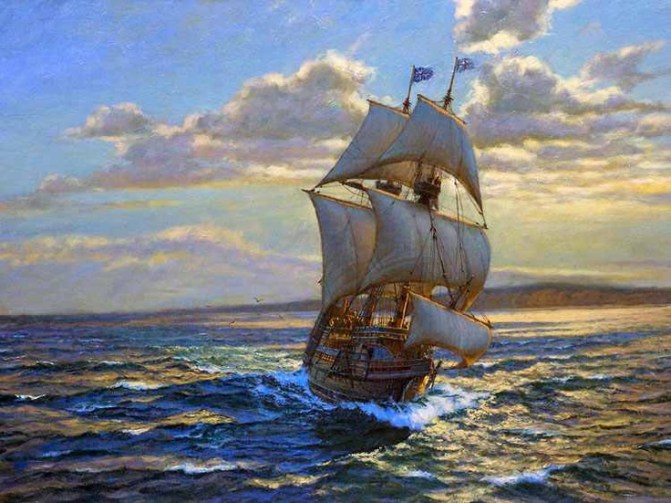
As autumn matures into winter and darkness begins to shade the vibrant leaves. A slight tug on the American imagination gets drawn toward the New England coast. With November ending and December ushering in the avalanche of Christmas, Thanksgiving is rushed out the door before it arrives. However slightly the memory lingers haunting America. These reflections on the origins of Thanksgiving and the Pilgrims have become overcast by cultural guilt and misconception. Like an abused child, America is uncomfortably reflecting on its past. Entangled by its bi-polar memory of glamorizing its history or magnifying the negative, Americans grapple with the good and the bad and how we arrived at our present state.
This polarization is now swarming around the historical anniversaries occurring over the next two years. Groups on both sides of the political spectrum demand a collective position to be agreed upon rather than an informed one. This past August was the four hundredth anniversary of the first slave ship to unload its cargo of human chattel in Colonial Virginia. To commemorate this event The New York Times has created and sponsored The 1619 Project, which according to its website “aims to reframe the country’s history, understanding 1619 as our true founding.” I am not suggesting that anything is wrong with the focus on this momentous historical event.
On the contrary, I welcome and gladly promote the focus and historical research that can be directed on this issue. I believe a society like any individual can benefit significantly by examining their past. For this introspection to be a worthy endeavor we must prove to have the courage to face the dark issues if we hope to grow from this ugliness. Unfortunately, the stated goal of the New York Times project suggests that it is more concerned with elevating slavery as the founding impetus for America rather than an aspect of its creation. I am fearful that this desire to educate is not grounded in beneficial historical research and reflection but rather Cultural Marxism that only hopes to increase a divide among the nation.
This same destructive impulse is what has pushed next year’s anniversary of the1620 landing at Plymouth Rock into the cultural melee as well. The Pilgrims of Plymouth Colony have sat aside both sides of the social pendulum. Heroes of faith and democracy in one generation then religious fanatics and genocidal monsters in the next. This black and white depiction is only reflective of popular representations of the Pilgrims and not representative of the complex group they were in reality. We should always be wary of wrapping flesh in marble. Michelangelo’s David, in all his splendid majesty, is cloaked in marble. The perfectly chiseled Carrera marble entraps the very flawed human that exists in scripture. History is misused if it is only applied to creating heroes of the past. It cheapens the very subject it hopes to deify.
It is difficult not to speculate on the motivations behind the New York Times’ dedication to The 1619 Project. For instance, their desire is to “reframe” our founding, not to educate society on the long-lasting impact of the slave trade. Or to enlighten Americans on the pivotal role enslaved Africans played in helping the colony survive. Instead they promote slavery in the context as “the real” founding. A position the same group formally claimed unimportant when it references Jamestown or Plymouth. This flimsy intellectual inconsistent argument calls into question the legitimacy of the whole project. They are tarnishing a potentially powerful study that could help to heal the long-standing racial wounds of the country.
My contention is that The New York Times desire to declare 1619 as the founding ignoring the obvious 1607 landing in Jamestown. It only signifies the cultural importance the founding does hold. Origins due matter, yes tributaries are vital waterways that should be traveled, but a journey to the source is invaluable. I will focus on how all three events are the keystones in American’s foundation, but for the sake of this thesis I will stay on this trajectory for this post.
What is it about the 1620 landing that makes the Pilgrim claim to the founding so dangerous for groups like The New York Times? If the cultural wars of the past fifty years have shown us anything, its that Pilgrims were, in fact, craven land-hungry, religious fanatics. According to William Loren Katz’s article on the Zinn Education Project website “Thanksgiving Day celebrates not justice or equality but aggression and enslavement. It affirms the genocidal beliefs that destroyed millions of Native American people and their cultures from the Pilgrim landings to the 20th century.” In reality this is configuration of tragic events that occurred for centuries over two continents to cover up the beauty of an actual event. Was the beauty of the moment fleeting yes of course, but the transitory nature of time does not extinguish its splendor.
What makes the Pilgrim’s claim to the founding so dangerous is there dedication and faith in the God of the Bible. Plymouth was not established by experienced merchant adventures or younger sons of the gentry seeker there a fortune. Instead, it was established by a small group of like-minded believers. Wholly devoted to the idea of pursuing their relationship with God unencumbered. They were not experienced in nation building nor were they ignorant of the dangers that awaited them. Still they were propelled by there faith across an ocean and held together by their shared hardships. It is not just the Christian faith of the Pilgrims that make modern secularist uncomfortable, it is the miraculous nature of its survival. The Pilgrims landing at Plymouth is not anymore the heralded founding then either Jamestown or the arrival of African slaves. The reality is that all three played a part it the creation of America. And it is the legacy of all three that we must learn to live with together four hundred years later.
“Thus out of small beginnings greater things have been produced by His hand that made all things of nothing, and gives being to all things that are; and, as one small candle may light a thousand, so the light here kindled hath shone unto many…”
William Bradford On Plymouth Plantation
Bradford, William. History of Plymouth plantation. Boston, 1856. 499pp. Sabin Americana.Gale, Cengage Learning. Liberty University. 20 November 2019 <http://galenet.galegroup.com.ezproxy.liberty.edu/servlet/Sabin?af=RN&ae=CY11 0674635&srchtp=a&ste=14
https://www.nytimes.com/interactive/2019/08/14/magazine/1619-america-slavery.htm1
https://www.zinnedproject.org./news/the-politics-of-thanksgiving-day/

 creaturesofgloryandunthinkablehorror.com