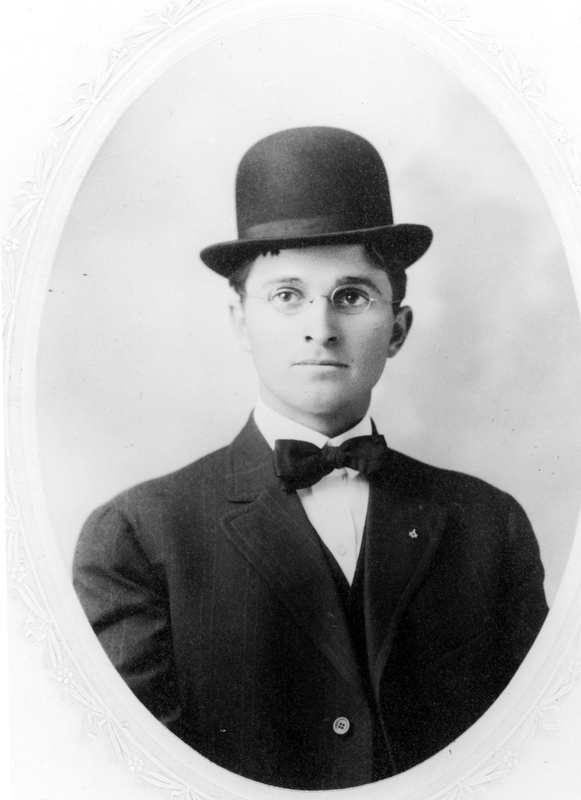
Historians have written numerous amounts of research on the years between the two World Wars. Countless inspections into Hitler, the soldier, and failed artist. Churchill, the failed politician, and outcast. Roosevelt’s rise to prominence and the plotting of revolutionary Stalin. However, among these mountainous stacks, most pay little to no attention to Truman. When he is mentioned, it is usually made in a comical tone that he was just a haberdasher. But the unassuming nature of Truman provides a powerful opportunity to understand the economic world of the period from a very base level perspective. His journey from his family farm to the Oval office may seem fantastical, and it is, but we can still learn much from his meteoric rise in the years preceding World War II. Additionally, what we see Truman the citizen encounter and overcome can help us understand Truman the President.
He was born in 1884 in Missouri into a farming family. The eldest of three children, his first memories were of being on a farm. His early years appear to be an idyllic vision of rural America during the turn of the century. Accompanying these memories was an emphasis on a work ethic that seemed to come preinstalled in all three of the Truman children. Poor eyesight hindered his childhood activities for fear of breaking his spectacles, so Truman escaped into reading and developed a love of history. Graduating from high school in 1901, he dreamed of admittance to either West Point or Annapolis, but his eyesight made him ineligible. Adding to this disappointment was the matter that financial troubles on the farm kept college from him as well.
So, at 17, Harry S. Truman enter the workforce. His first job was as a timekeeper on the Santa Fe Railroad making $35 a month plus room and board. This position was the first in a series of jobs that moved Truman smoothly up the levels of employment over the next fifteen years. His intelligence, work ethic, and reliability granted him new opportunities that seem to come with each year. Each new job came with an increase in responsibility but also an increase in income. In addition to his own professional movements, there was much activity on his family farm. Farmland and cattle seemed to shift hands regularly as both were passed on to the next generation, and opportunity for land was always seen as a sound investment. At one point, Truman’s father traded his home for 80 acres of land he hoped would provide an excellent opportunity for the family. This entrepreneurial instinct was an aspect that united the family and seemingly kept them close in spirit if distance separated them. And when his first chance at a significant venture, came knocking Truman answered.
In 1916 two friends approached him with the idea of buying into their upstart oil company. With help from family and one thousand dollars invested, Truman became a one-third partner and treasurer in Morgan & Company. David H. Morgan, the president of the company, would travel between Texas, Louisiana, Kansas, and Oklahoma and lease land in the hope of finding oil. The business plan was sound, but the timing was off by a millisecond. Not for the last time in his life, Truman would be the victim of larger events that would be out of his control. Before Morgan & Company could find oil, the company was forced to close when the United States entered World War I. In 1917 while now Lieutenant Truman was fighting with the Allies in France, an oil company that had purchased one of Morgan & Company’s wells “struck the Tetter Oil Pool, one of the biggest oil reserves in Kansas.” Years later, Truman pondered how his life might have been different if they had struck oil before the U.S. entered the war.
In the spring of 1919, Truman returned to Missouri to work his way back to where he was financially before the war. After his marriage, Truman entered another business partnership with his friend, Eddie Jacobson. At 35 years old, Truman opened a “men’s furnishing goods” store in Kansas City. He was the store salesman, with Jacobson acting as the buyer. Truman sold his stock in his family farm and invested $15,000 into the business. To start the business, they purchased $35,000 of inventory for the store. In the first year, they had a return of $70,000 on their investment. Apparently, “Give ’em Hell Harry” would not take no for an answer as a salesman. But once again, just when Truman believed he had finally arrived, fate intervened once again. After an opening year of brilliant success and a sophomore year appearing to follow suit, both owners were excited about the future. Writing decades later, Truman could not hide his frustration with the events he blamed on President Harding’s election and his secretary of the treasury, Andrew Mellon. According to Truman, Mellon’s actions plummeted farm prices impacting his own business. Proud and ambitious both owners refused to sell their inventory at cost, believing they could weather the storm. Between January 1, 1921, and January 1, 1922, their inventory valued at $35,000 had fallen in to $10,000. No amount of hard work or determination could fight that amount of economic turmoil.
The failure of the business was not their only concern. Both men had taken loans out to get the shop up and running. The clothing store was not the only business impacted by the squeeze of 1921; banks succumbed to the pressure as well. Two of the banks they had dealt with were forced to sell to larger banks themselves. With blood in the water, the sharks came for everyone who owed the banks. Jacobson and Truman found themselves in a situation of not wanting to go bankrupt but battling mounting debt. For years they both did what they could, but in 1925 Jacobson declared bankruptcy. The banks took Jacobson’s forfeit as an opportunity to pressure Truman, but again he resisted. Finally, after “making payments as small as $25,” he was able to pay off his debts without going bankrupt.
“This was hard for me to experience at the age of 38.” It is challenging even to envision the man who would guide America through the last stages of World War II in such a position just a few decades before. Nevertheless, his upbringing on a Missouri farm, his work ethic, and the resilience that carried him through his financial troubles would translate to his political career. And that same determination would become a hallmark of his time in office.
Truman, Harry S., and Robert H. Ferrell. The Autobiography of Harry S. Truman. Boulder, Colo: Colorado Associated University Press, 1980.
Geselbracht, Raymond H. The Memoirs of Harry S. Truman: A Reader’s Edition. Columbia: University of Missouri Press, 2019;2020;.
Hamby, Alonzo L. Harry S. Truman: Life Before the Presidency. https://millercenter.org/president/truman/life-before-the-presidency
Harry S. Truman in 1908. https://www.trumanlibrary.gov/photograph-records/84-38

 creaturesofgloryandunthinkablehorror.com