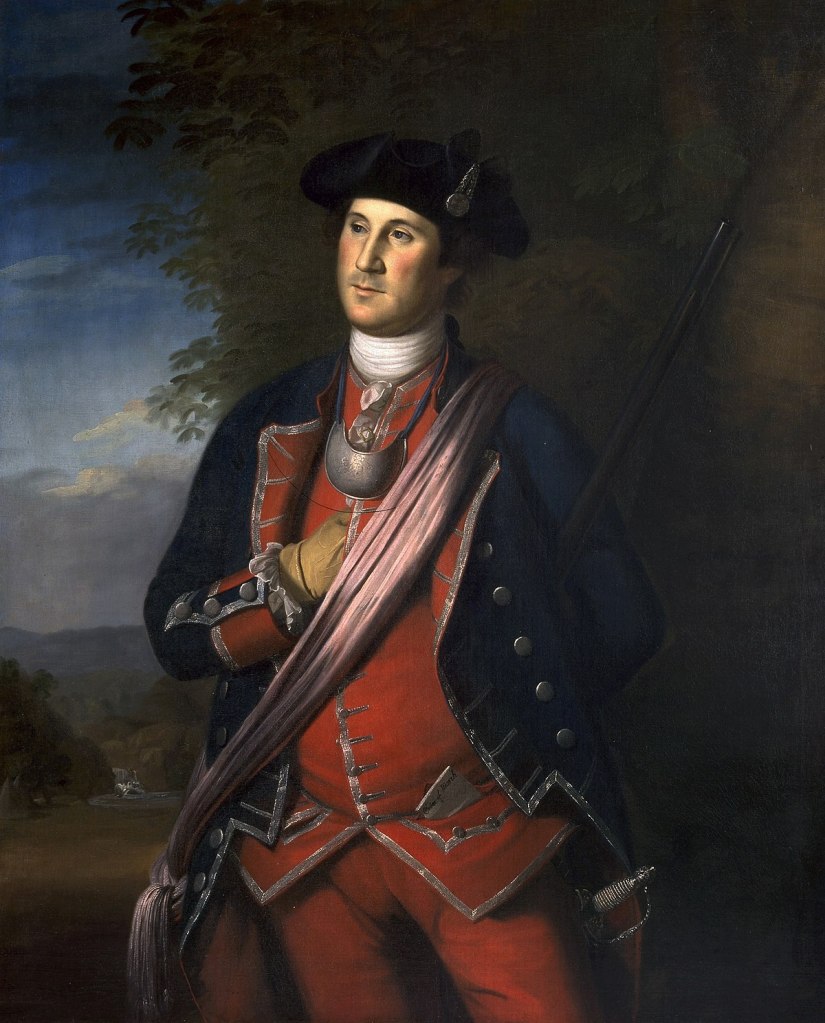
George Washington cast a vast shadow across the landscape of American history. Scholarship over the past fifty years has done much to illuminate him and the members of his generation. However, Washington still remains elusive. It is not for lack of trying. A myriad of works have attempted new perspectives on Washington to present him in a revealing light. Somehow, he manages to pull away from each grasping attempt to keep some aspect of himself private. Much of this distance is due to his own making.
Washington actively cultivated a certain amount of distance even among those closest to him. This distance may have reflected his military background, the emotional detachment of a man who must lead men into battle. Or, if we placed him on the couch, he might reveal that the remoteness was a shield he created after losing his father and brothers at a young age. Ironically it has become an aspect of our national mythology to envision Washington and his father standing over top of a fallen cherry tree. In reality, the image we should consider is that same boy standing over top of his father’s grave. Somehow that fragile image of a heartbroken child evades us. It demands too much of our imagination to picture the father of our nation as a devastated young boy.
Justifiably, historians tilt heavily toward the second half of Washington’s life. Unfortunately, we get a disjointed understanding of the central figure of the nation’s founding. Almost all recent works cover aspects of Washington’s early experience in the French and Indian War. The French and Indian War offered a brutal proving ground for the young, ambitious officer. Historians have recounted how he stumbled into the conflict, accidentally triggering a regional dispute that became a global one. Even though this aspect of his life is detailed, there has been a failure to show how these experiences provided a formidable education for Washington. Although his biography has become frequently covered ground for historians. There remains a path of research that breaks from the well-worn trails. This path presents a reckless, arrogant young man who has the virtues of a leader beaten into him.
Within the Imperial and cultural clash of the Seven Year’s War, we can best understand the Washington that arrives at the First Continental Congress dressed in military attire. It is an odd decision to arrive at a political convention dressed in a military uniform. This story is often cited by historians who have assumed it was Washington silently announcing his desire for command of the army. What is overlooked is that his arrival in his uniform reveals far more about how Washington viewed his time in the French and Indian War. Washington’s uniform was a garment soaked in the experience.
The war was a complicated, brutal affair fought in the North American wilderness. The two belligerents had to hack through the forest to get at each other. Britain and France were both heavily reliant on their Native American allies. At the same time, Indian forces hoped to play the two European powers off each other to re-establish their own dominance. It should be viewed as a battle between three empires rather than two. Each group struggled to hammer their way of life and culture into the unforgiving terrain. It was a war that ignored European rules of engagement. Battles were fought in the dense woodlands concealing the two forces from each other. With no set battlefields, the horrors of warfare slammed into the lives of the civilians living along the middle ground. Europeans and Natives alike experienced this inhumane brutality giving this often-overlooked war a distinct tenor that would impact all who lived through it. Washington’s battle scars were earned in this backwoods brawl and would texture how he conducted himself and the Continental Army during the Revolution. A conflict that taught him the harsh realities of war, the price of leadership, and the importance of survival.
This is why a detailed study of this period of his life presents an essential opportunity to understand the man. There are aspects to this investigation that demand a military perspective, but the importance goes far beyond a straightforward discussion of military tactics. This war profoundly challenged how Washington viewed the world. Foundational aspects of who he was and the world he lived in would be forever changed. Matters considering his Britishness, the British Empire, the reality of empires in North America, and Virginia’s place in that empire. Aspects of government, leadership, ideas of republicanism, and unity of the colonies can all be traced back to his experiences in this fierce struggle. Conversely, a view into how these events impacted Washington will not only help to illuminate this central figure. It can also provide greater insight into the founding and potentially ourselves.

 creaturesofgloryandunthinkablehorror.com